Long winding intro
For those who are interested, swaying away to the right there, that’s the Old Bridge, that was replaced by the New Bridge in 1972. Funny thing, the Old Bridge used to be called the New Bridge. Yeah, it’s bit of a funny one
Bus Driver’s Song, by Flight of the Conchords
The Intercity Nieuwe Generatie, ICNG for its closer friends, is the nieuwest train used by the Nederlandse Spoorwegen (NS). But I will have to wait a few decades for the joke above to land, as these trains are meant to replace the locomotive-driven Intercityrijtuig (“Intercity carriages”; ICR), and part of the Intercitymaterieel fleet (“Intercity rolling stock”; ICM). The ICNG joins a further acronym called SNG (Sprinter Nieuwe Generatie), and someday the DDNG (Dubbeldekker Nieuwe Generatie).
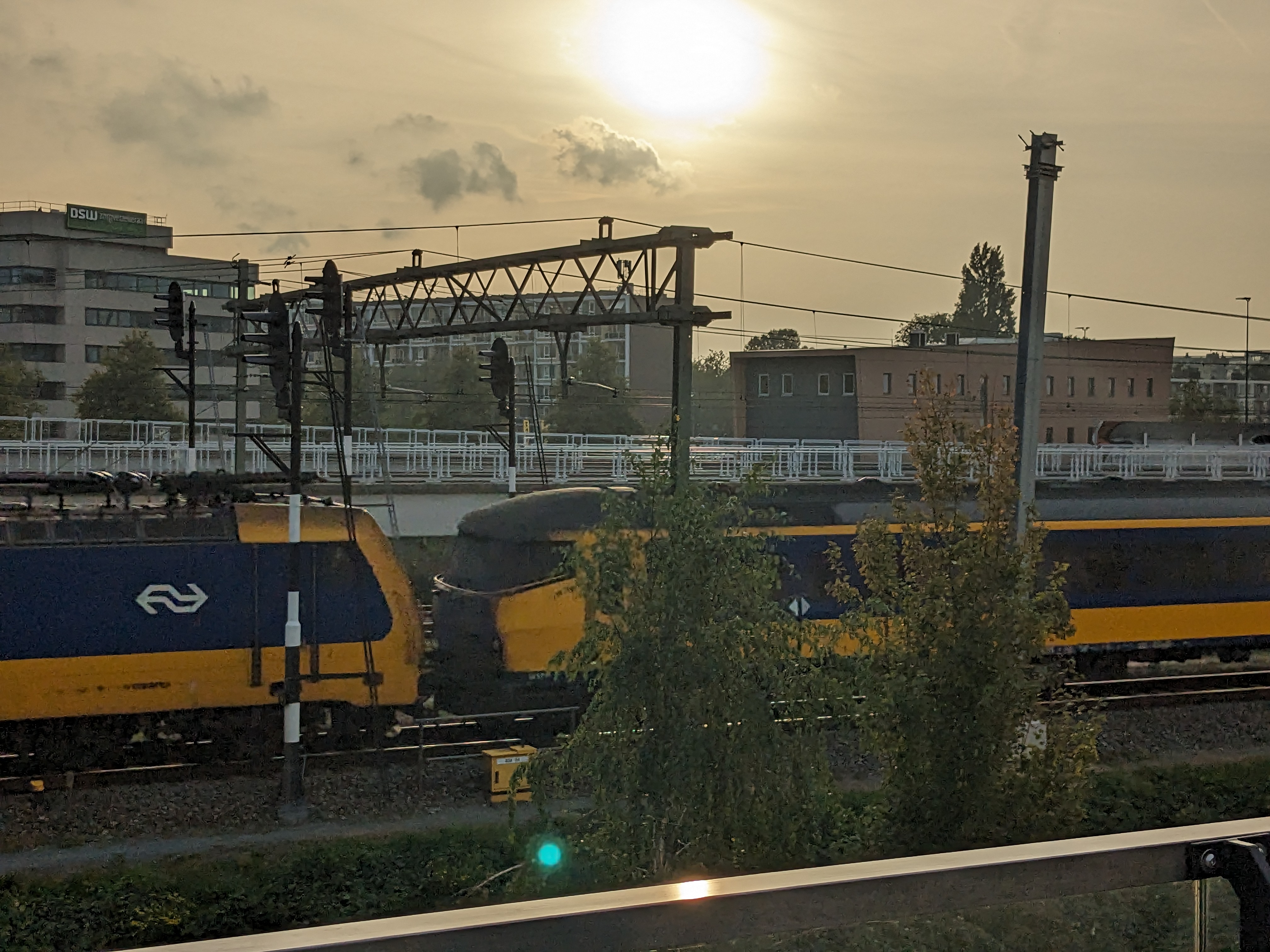
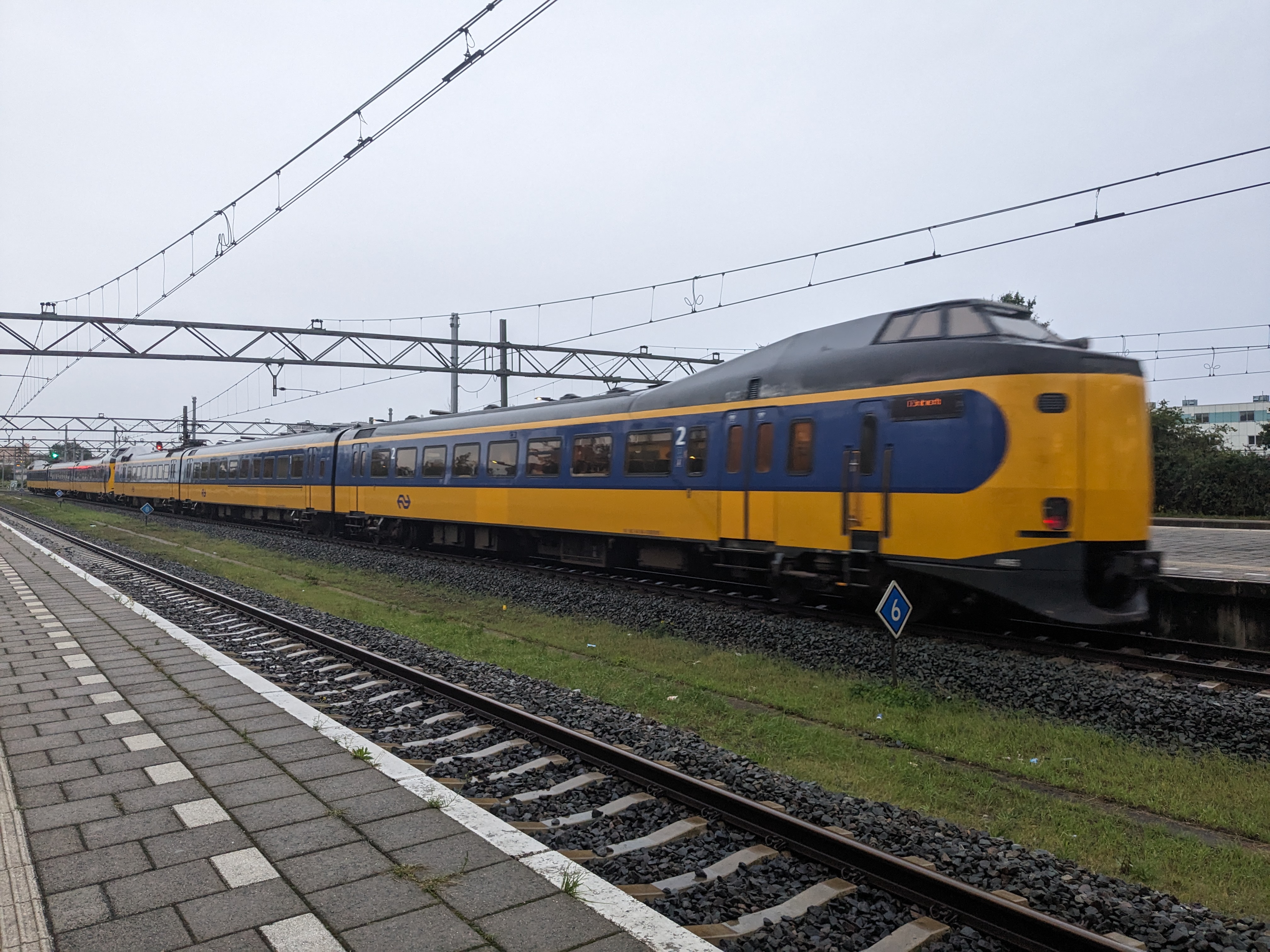
Some 45 years after the Shinkansen started its operation, the Netherlands opened its own high-speed rail line, named HSL-Zuid. Eventually, a good part of this 300 km/h line between Rotterdam and Amsterdam was downgraded back to low speeds after they realized a series of 10 viaducts were poorly designed. It is currently three years after this discovery, and a month after construction work began on a permanent solution. The current estimate is that repairs will take another 6 years. As this post illustrates, nothing ever goes wrong, so I’m sure the fix will be ready on time.
HSL-Zuid enabled fancy trains to go from the two largest Dutch cities directly to the capitals of Belgium, France, and the UK. But to get back the money they begrudgingly spent to maximize public benefits, the Dutch government also conceded the track to NS for it to run domestic and shorter international services on it. NS International was rearranged, a partnership with KLM was formed, and trains capable of 250 km/h were ordered for a service to Brussels, dubbed Fyra. Delivery of these fast trains was delayed, so NS rented a bunch of TRAXX locomotives from a train landlord (“rolling stock company” if you are feeling charitable) and started the service using the aforementioned ICR carriages.
Long story short, the V250 trainsets started running December 9, 2012, and would have a fondly-remembered career until January 18, 2013. It was decided the best course of action was to rebrand Fyra to Intercity Direct, paint the slow carriages a different color, and forget anything had ever happened.
In 2014, NS said they could tune-up the TRAXX-ICR combo to run at 200 km/h in as little as two and a half years, but it was preferable to buy newer trains instead. This time, they would be less ambitious, with 200 km/h trains to be slotted in between the 300 km/h trains from Thalys / Eurostar. They would buy a model that was already in use elsewhere, and they would test it thoroughly before committing to a start date, which would be no earlier than 2021.
Intercity Defect
A decision was made later in 2014, and in 2016 the ICNG was ordered from Alstom, with entry into service being aimed for 2021 as recently as in 2017. The first unit was received in the Netherlands on May 23, 2020. But, afraid of a second Fyra hitting their proverbial World Trade Center, NS would continue testing for almost three years before there was enough confidence to start passenger service.
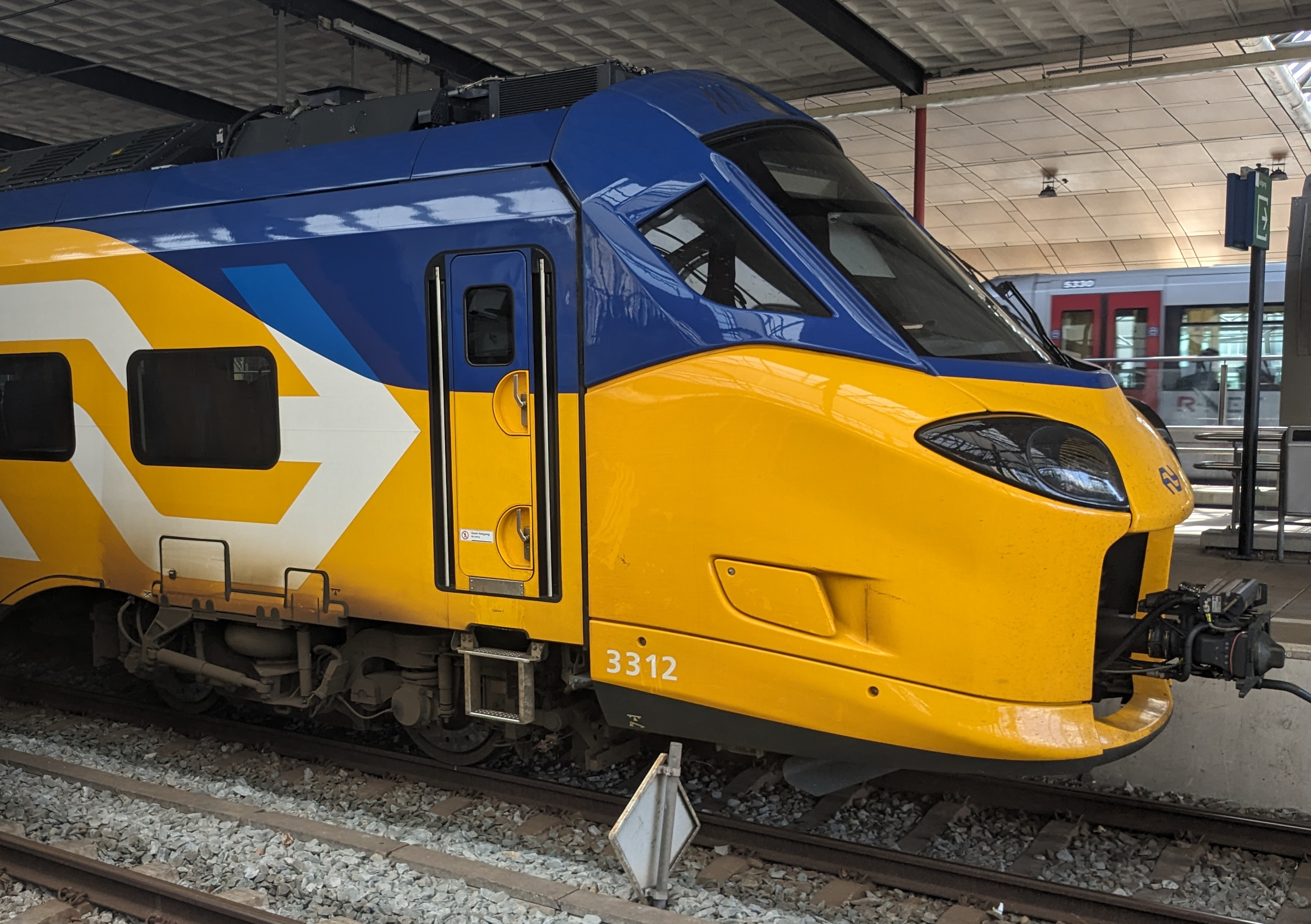
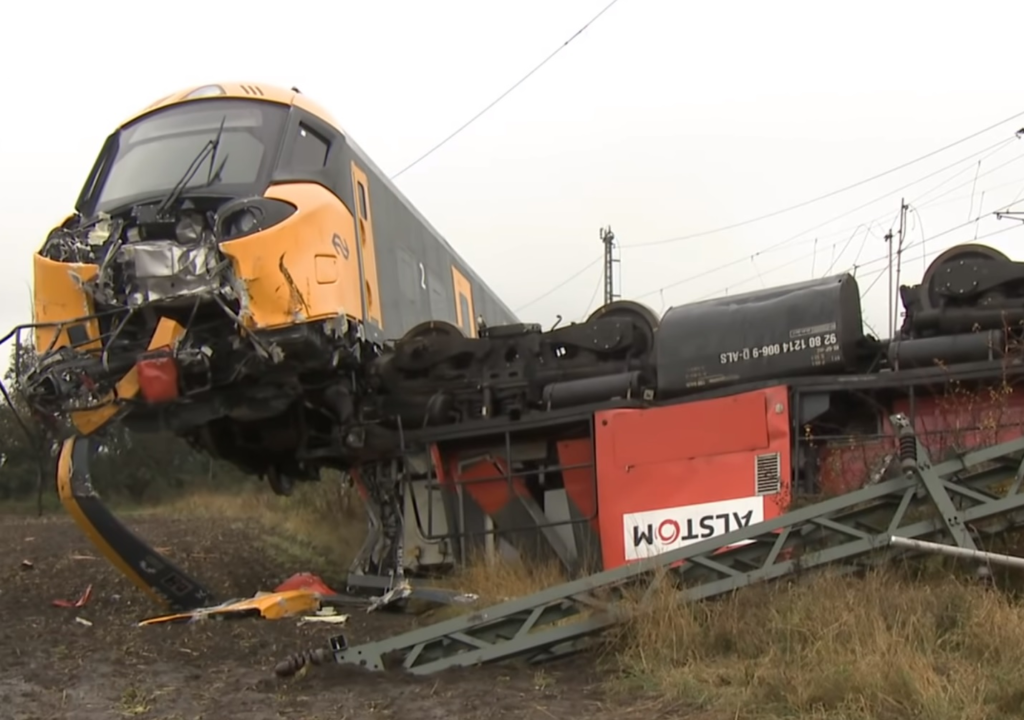
The pandemic in 2020 was naturally a good first excuse for the delays. As was a small derailment in Germany, which was not the fault of the two ICNG units being towed, although the optics certainly weren’t ideal for Alstom, who I assume also made the locomotive pulling the consist:
Hopes of a 2022 launch were quashed by discovery of serious technical problems, including poor weld quality and software issues. The news broke only in November of 2022, but the issues had been identified back in March of that year. And in any case, even before that, at the end of 2021, an external report commissioned by the Ministry of Infrastructure and Water Management (I&W) had already established that the original planning was no longer feasible:
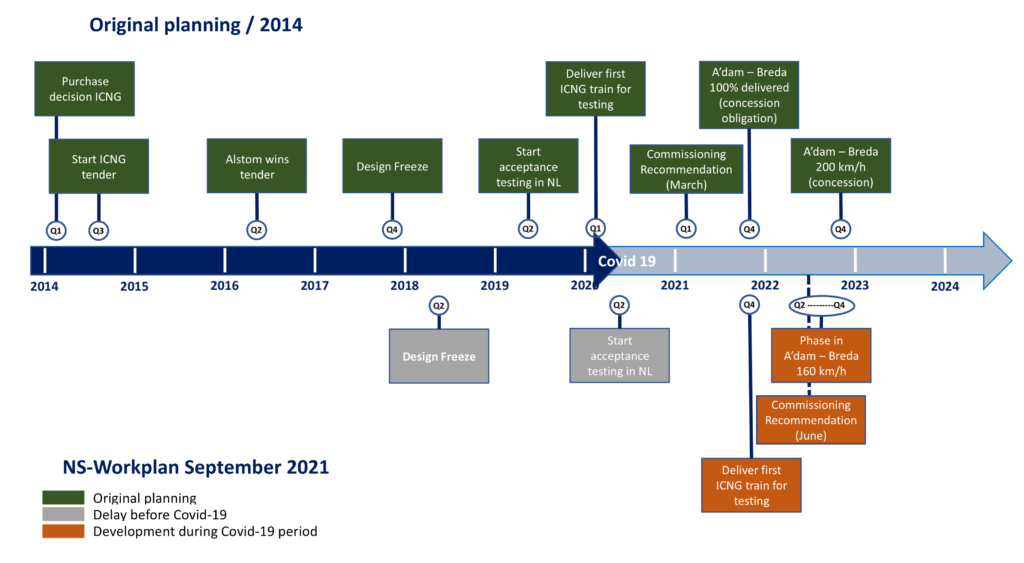
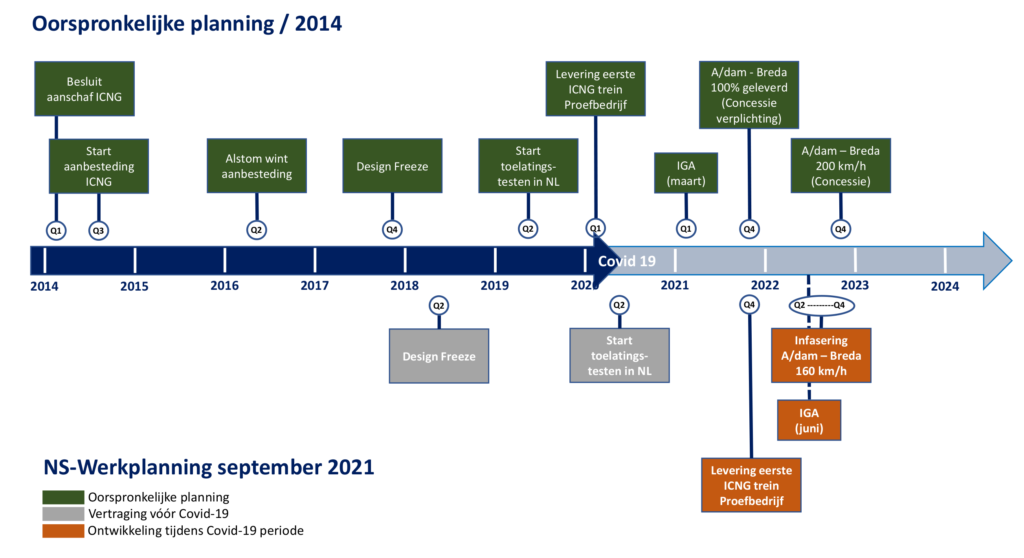
But the wait was over when, on April 19, 2023, passengers boarded the ICNG in commercial operation for the first time. After which, the new trains immediately ran into technical issues (the very first day, if you were too lazy to translate the article linked). One day before start of operation, the Secretary of Infrastructure and Water Management sent a letter to the House of Representatives recounting this history of delays and updating them on the current outlook: defective trains would be returned to the factory in Poland for fixes and retrofits, and the last train should roll out of the production line only in 2025. Scheduling risks had been raised earlier in 2023 by a second external review commissioned by the I&W, as promised to the House:
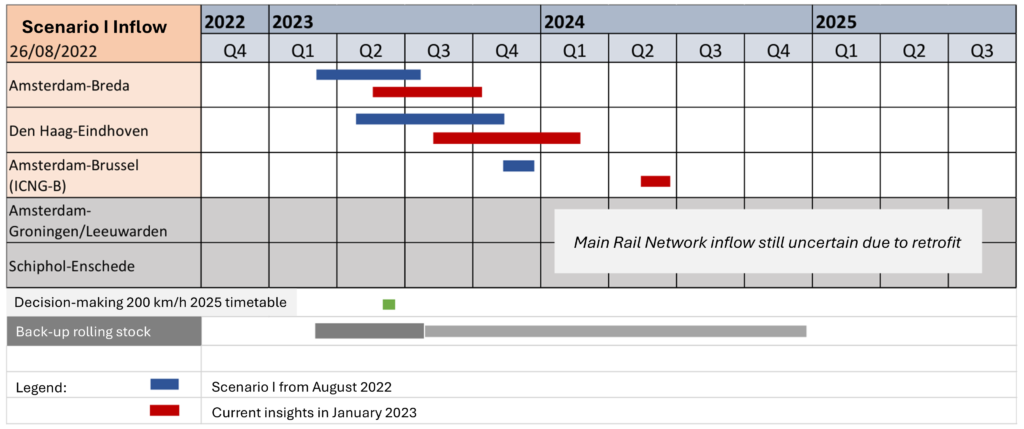
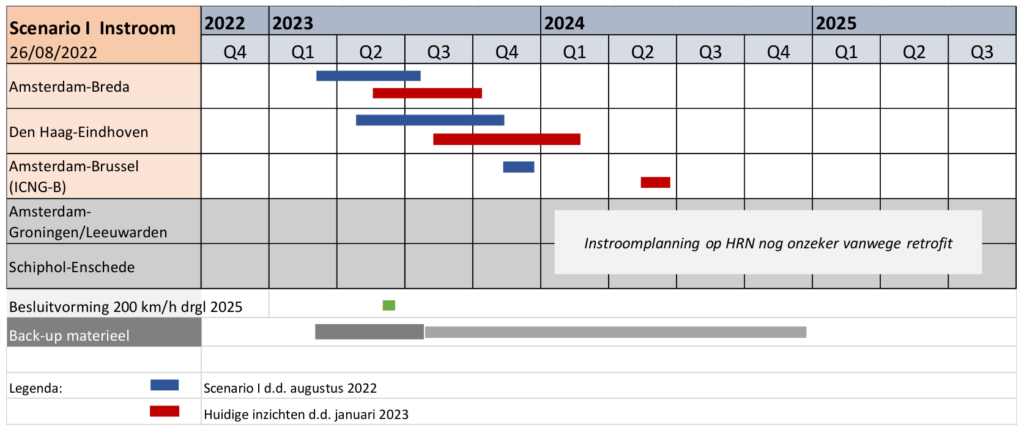
The narrative that NS put out after launch was that those problems were improving, although half a year later the ICNG’s track record wasn’t really stellar. And as that last article reported, despite all delays up to that point, NS was promising that deliveries would pick up pace and all 99 units would be in operation by early 2026.
Come 2024 and 10 extra units were ordered for international services (I go over the variants below), bringing the total to 109. But delivery of new trains is so slow that Germans start to wonder why there are so many trains parked on their tracks for months now. On July 26, the NRC newspaper publishes this amazing article investigating the whole story, and doing a much better job than I ever could at describing this situation. NS puts out a news brief the same day with their (indirect) response.
So, just a quick list of officially acknowledged technical issues that affected the ICNG:
- Defects in welding the aluminum body, compromising their lifespan.
- Erroneous indications of brake failure.
- Interior sliding doors not working properly.
- Water ingress through the cabin door.
- Noisy and uncomfortable climate control system.
And a list of additional issues mentioned anonymously by a conductor, which are not necessarily systemic:
- Fire door not working.
- Adhesive wrap peeling out.
- Layout of door buttons prone to errors by conductors.
I should also add anecdotal complaints I’ve heard:
- Typically fewer seats than the ICR trains.
- Emergency button placement causes accidental presses too often.
- Significantly less room for trash disposal, causing more littering.
Software updates should be able to fix all of that, especially now with AI and such. So for our plot today I will only look at how delivery went, as it’s already 2026. Wait, I mean how delivery is going.
NS had received enough trains to finally retire the old ICR trains in October 2025, in triumphant fashion. But as we will see, deliveries will continue into 2026 (and beyond?). Relatedly, I rode in an ICNG in September last year (2025) and noticed a strong “fresh train” smell. A quick search on my phone indicated that the unit had started service just a week earlier. The door separating the compartments next to me was out of service.
ICNG variants
Before looking at delivery data, here is a quick explanation of the different variants of the ICNG that NS has ordered (also here):
- ICNG-V: domestic trainset with 5 cars.
- ICNG-VIII: domestic transet with 8 cars.
- ICNG-B: 8-car trainset for international services to Belgium.
- ICNG-D: 8-car trainset for international services to Germany.
Implementation started with the domestic services, with Belgium-bound trains following a few months later. After the ICR carriages were retired, the Intercity Direct services to Brussels were no more. As of December 15, 2025, the era of Eurocity and Eurocity Direct began. Eurocity, the service with more stops, is being operated by Belgium’s NMBS/SNCB, while Eurocity Direct is operated by NS using exclusively the ICNG.
As of writing this, the German-speaking trainsets are still in early testing. They will be used for a new, not yet publicly disclosed international service (extending the The Hague – Eindhoven line to Aachen?).
Tracking trains on tracks
When you are on the platform wondering where is the train that was supposed to have shown up already, you check treinposities.nl. This website (and I’m sure there are others like it) uses real time tracking data provided by NS so that you can follow the (damn) train.
That website also maintains a database of rolling stock, including some extra information added by its community. In the overview page for the ICNG, you can see (depending on when you are reading this) that the last position for a lot of units still reads “Wacht op aflevering” (waiting for delivery).
On the details page for specific trainsets (e.g.) there is a table indicating when their status has changed, such as when they are put in service. It seems most of these are filled automatically when the feed data indicates a trainset is running, but there are also data manually added by moderators. It’s not perfect, but that is fine for our purposes here.
Using this as a data source, my goal was to plot how has delivery gone over time, because despite reassurances from NS, it felt like it was slow. I scraped the website on December 20, 2025 to get a list of when each ICNG trainset was put into service.
There were a few cases of trains that started commercial operation and were later sent back to Poland for rework, which seems to be somewhat recorded in the data. My initial analysis just looked at the date when each operational trainset was put into service (for the last time). It was clear this wasn’t ideal because the plot showed no trains in operation on April 2023. I later refined this to account for trainsets being put into and out of service, with the plot then going both up and down.
The plot
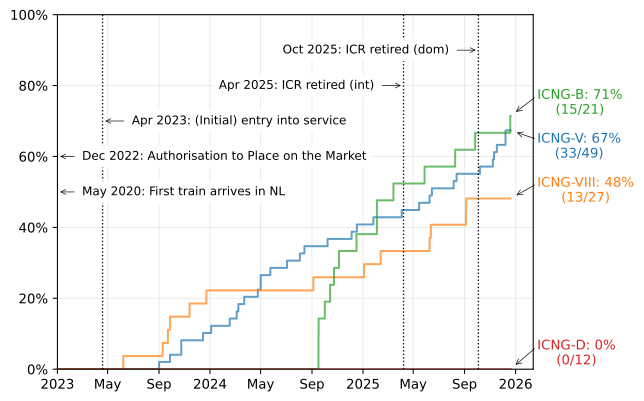
All -V and -VIII trainsets should have been in operation “early 2026”. Let’s see how things were going as of the end of 2025:
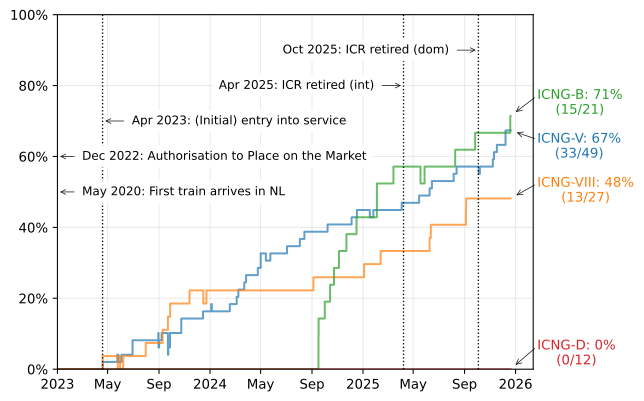
Still a long way to go it seems. In terms of number of domestic cars, we were at . No wonder why you can still see crowded trains with just a single 5-car unit during rush. It’s also no surprise that service in the Breda – Rotterdam – Amsterdam route hasn’t been extended to Leeuwarden, Groningen or Eschede yet, although some trains do run all the way to Lelystad now.
The rollout of the smaller -B fleet seems to have been quicker. I’m guessing these units didn’t suffer as much from the weld issues due to entering production later. And maybe the pending commitment to start the EuroCity product with NMBS/SNCB in the 2026 timetable caused the delivery of the -B trains to be prioritized?
Finally, a sequence of work-in-progress plots is show below. These use the first version of data processing, which didn’t account for trainsets being removed from service then being put back into operation.
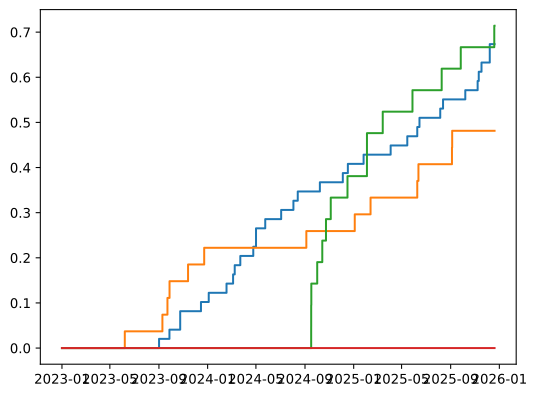
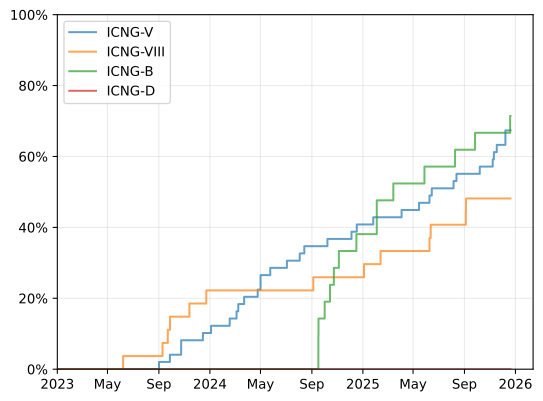
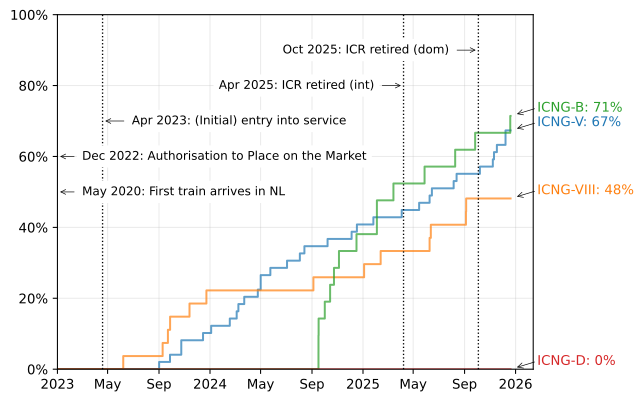
As always, progress is slow. Both in railway engineering and in me writing posts. But one day in the future, these intercity trains won’t be new anymore. And I hope to get to be old enough to make an update to this plot in which all the lines reach 100%.
Leave a Reply