Pre-intro post scriptum
Oh the irony… This was the original post when I had the idea of making this blog. It centered around me complaining about how things always get delayed, starring Delft’s tram line 19 as the example of how something seemingly so simple ends up being late by several years.
I compiled the data at the end of 2024, made the plot in January 2025, and half-wrote the post in April 2025. I then got busy due to a case of increase in scope of my nuclear family, and the website was sent back to the dusty unrealized personal projects shelf.
I have made the commitment of only making this whole blog live once I had made at least 5 posts (check) and had finished this one, The Original Post. So here it goes. I only updated the plot because I found a new data point to add to it.
Long winding intro
When I’m feeling discouraged about the present, I like to think of nice things I can look forward to. These include, of course, major construction projects promising to make life better when completed. New transit infrastructure, for example.
But if you have ever followed such a project, you probably already realize how this coping mechanism is certain to backfire. Accepting the inevitability of multiple delays and cost overruns reveals that checking in on these projects is only yet another thing to feel angry about.
They say acceptance is the last stage of grief, and since I’m here to procrastinate, that will have to wait. Line 19 of the Haagse Tram is as good as any candidate for official hopium supplier to my ADHD-saddled brain. A new tram line extension that would pass right by my workplace at the Delft University of Technology, connecting it to the city’s center and its railway station. It is not just a good bit of infrastructure, but one that would benefit me directly.
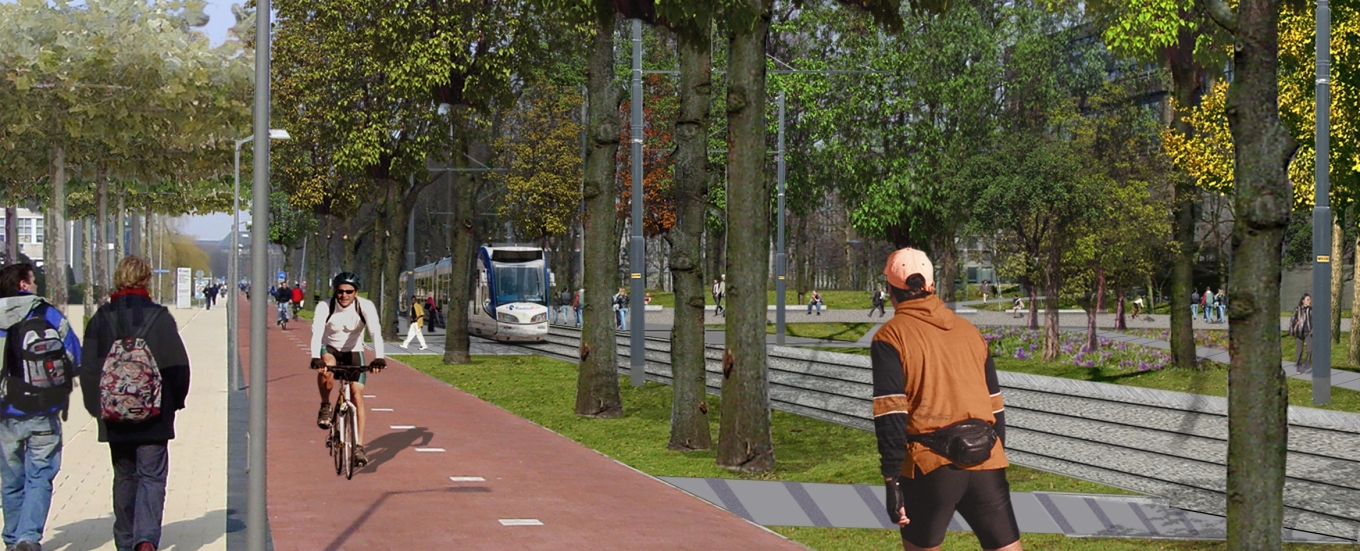
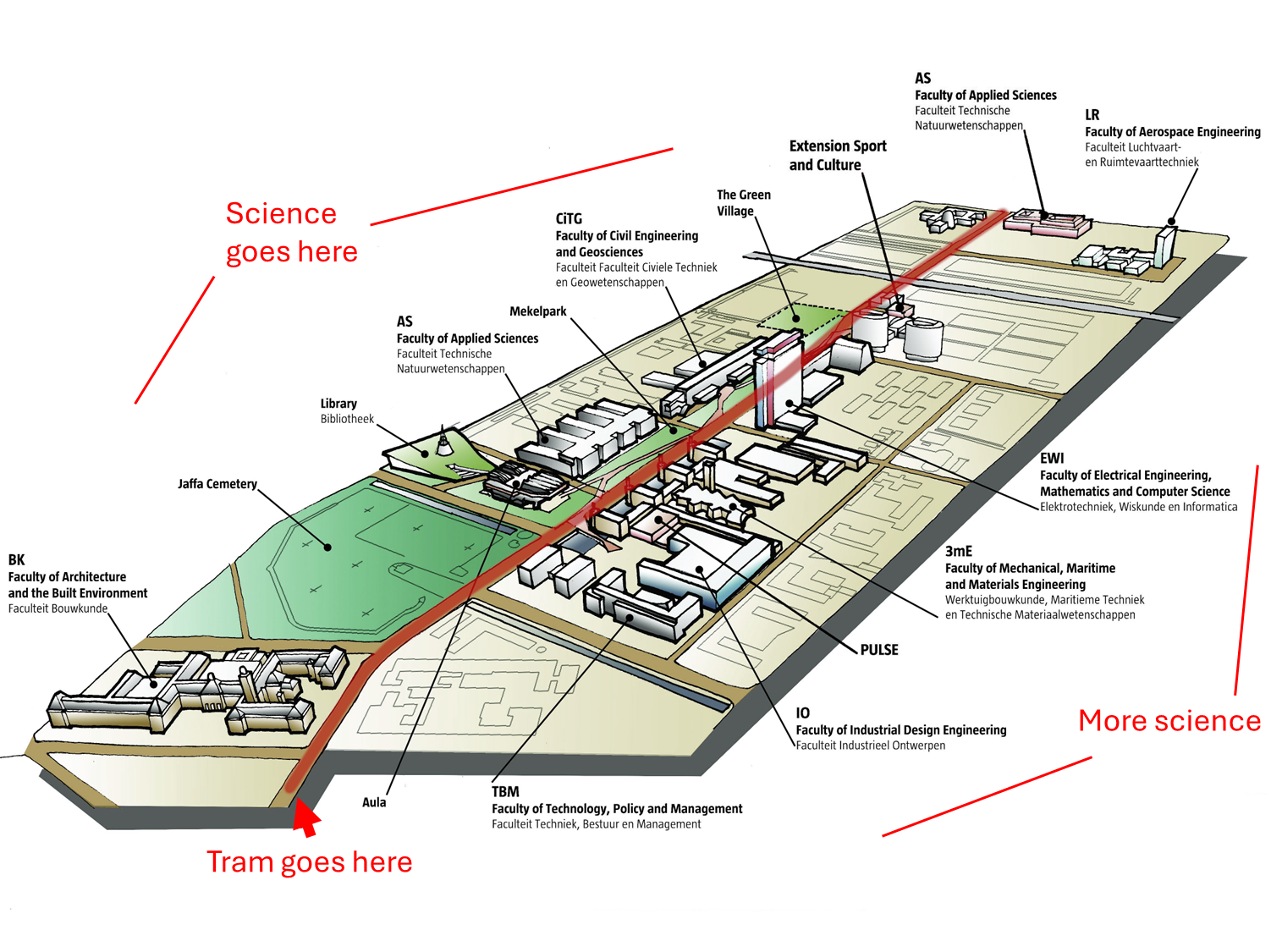
The line is impossible to miss. It cuts through the campus right down the middle, flanked on both sides by the various buildings sheltering the great minds that… apparently were against the line being positioned there? Just think of the impact on the poor parking facilities, or the harm it would do to the concept of the campus! We should be scared that one day the line could potentially be upgraded to an even scarier form of transport, light rail (sneltram is the term used)!
I presume that the municipality won against the visionaries at the Executive Board of TU Delft, because whenever you had to go from one building to another, there it was, at the very center of it all. Those unmistakable trails of extruded steel buried flush with the concrete pavement, on which buses ride with frequency, collecting students and the occasional confused visitor, unsure why there are no trams to be seen on top of the suspiciously rust-tinged rails.
In anticipation for the trams, tracks were installed sometime before I joined the university in 2019. Since then, opening day has always been just around the corner—like the bus that should have arrived three minutes ago according to the timetable, which any moment now should get unstuck from traffic and come to your rescue. But the ride never ends, because as of early 2026 tram 19 is yet to even start riding through TU Delft.
This feels unjust. It feels like I am constantly being cheated out of the final gratification of this obsession. If there is no ultimate benefit, have I just been wasting my time dwelling in anticipation? It feels like the world is rigged such that good things never actually happen. It makes me want to look at the project closer so that either I find the hope and positivity I was looking for in the first place, or at least I find definitive proof that this is really unfair—that things are just systematically hopeless, and I am the clueless sucker who keeps pulling the lever on the slot machine expecting a good outcome.
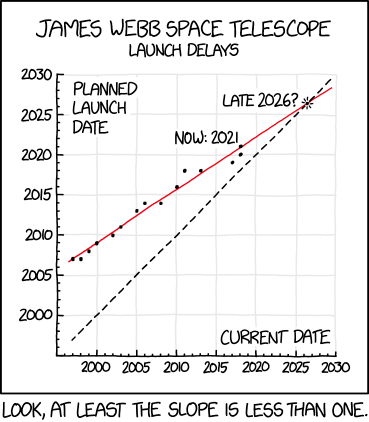
Thankfully, there is always a relevant xkcd. Long before I knew about public transit in these lowlands, I looked forward to the greatest space observatory ever, the James Webb Space Telescope. Same deal: cool nerdy contraption promised to be delivered in the future. Sadly, the project was also infamous for multibillionairily large delays. That comic from 2018, 15 years after the signing of the construction contract and 3 years before the eventual launch of the telescope, managed to tell that story in a way I did not think was possible.
The graph remarkably captured that feeling I had; it contained the proof that we were being constantly let down. Not being as negative as I am, however, the comic has a positive hopeful message, that at least the slope is less than one. To optimism’s credit, the spacecraft did launch eventually—in fact, it did so at the end of 2021, just as the last (non-projected) point suggested.
So that’s the prompt: I wanted to apply the same analysis to other such projects. That is, make the same plot for other cases, exposing the ugly truth about delays that every press release and ribbon cutting ceremony erase with determination. The idea stuck with me, and eventually I saw Tram 19 as a good subject to try this with.
First trial (of the plot, not the tram)
Sorry, one more stop on our way. This is a tale of belatedness after all. In truth, the first opportunity to try out this plot format actually came from another bit of transit infrastructure.
As part of a wider program to increase train frequencies in the southern part of the Oude Lijn, which connects the second and third largest metro areas of the Netherlands, a decent portion of this right of way was being upgraded from 2 to 4 tracks. This included reactivating two platforms at the Schiedam Centrum station which used to go to the sea at Hoek van Holland, as well as reconnecting them to the tracks towards Delft and rearranging the track layout accordingly. The result would be more Sprinter trains (that’s the local service), six per hour at peak instead of four, and capacity for extra Intercity trains (the longer distance service) that wouldn’t necessarily stop at Schiedam.
That would be great for me. 15-min intervals are not bad at all, although by that time the timetable annoyingly had a Sprinter in alternating intervals of 10 and 20 minutes. But 10-min is the magical threshold when I wouldn’t even bother looking at the clock before leaving for the station. No more rushing or detouring for a frikandelbroodje when the next train didn’t align with my morning RNG seed.
But as the saying goes, no geen-trein, no gain. Or something like that.
The Dutch seem to love to renovate things. I guess that’s the unadvertised price of having well-maintained infrastructure: maintenance is annoying. Summer vacation is understandably the preferred time for public inconvenience. Quoting myself at the time, complaining to my coworkers:
“To recap: from July 13 I won’t be able to take the footpath I usually take (which will be closed) to get to the train station, where I won’t be able to catch the train I usually get (which will not run) to the other train station, from which I won’t be able to cross the bridge I usually cross (which will be closed) to get to the office. But none of that matters, because I won’t be able to work at the office (which will also be closed). Cool”
Replacement bus service would run instead of the train from July 13–27. Brought to you by completely clueless Croatian coach drivers who might have never been to the Netherlands before, only speak Croatian, and whose employer I’m guessing offered the lowest price to NS. It was actually fine; and the drivers too, I was just amused by how lost they were on the first day. Still, the longer, less comfortable journey was extra annoying in the heat of summer. Especially when carrying a toddler along, who is not entitled to her own seat.
A mere two days before the restart of service and a delay of a couple of days was announced. Halfway through the now four-day wait, a new delay: just one more day. At least the slope is less than one.
In an unexpected turn of events, the next two days brought more delays. Plus one, then plus three days. Out of frustration, the following figure was born:
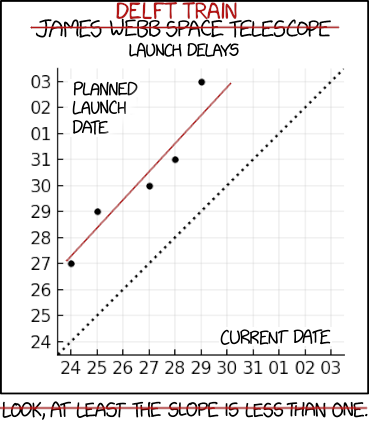
But despite the setbacks, it was all good in the end. In fact, trains even ended up running a day earlier than the last forecast plotted. The reason for the delays was that they couldn’t finish the signaling system in time, and the people who knew how to do that were all busy after the time window originally scheduled for the job: “However, these skilled workers are currently difficult to find. This is due, among other things, to a tight labor market”. I love how, in the best economic system ever devised, low unemployment is a worrisome bad thing labeled as tight labor market.
Back to the tram
I really liked the format of that xkcd, but it needed a final adjustment. Drawing a 45° line and an almost 45° line doesn’t do justice to the fact that the latter should be at 0°. Doing a little change of variable, or just tilting your head an eighth-turn to the right while keeping the x-axis steady, reveals a nicer format for what I was looking for. The y-axis becomes “time to launch”, which is expected to always go down at a 45° angle until it hits the ground (maybe I should have flipped it, so it went up to the ceiling?). Crucially, any delay is clearly seen as a straight line “jump” that pushes us away from the big moment, kind of like this.
So my plan for the plot was simple: find out how the opening date of the Tram 19 extension to TU Delft changed over time, and make a “countdown” plot. All I needed was to lookup what was the original planned opening date, and what were all the subsequent ones.
But first, we have to ask the question: what is line 19? The one I’m writing about is a line, the newest, on the tram network of The Hague, a city that line runs through only tangentially. Line 19 connects the town of Leidschendam, through the Hague’s district of Leidschenveen-Ypenburg, to the main train station of the city of Delft, some eight kilometers from the center of the Hague. It opened July 1, 2010; and you can read more about its history on Dutch Wikipedia.
But as evidenced by the article from 2004 I referenced in the introduction, the plan was always for the line to diverge from line 1 at the Delft train station, pass through the TU Delft campus, and terminate at the science park just south of it. This last ~3.5 km bit is the “extension” that is yet to materialize.
The earliest expected “opening date” I could find was “end of 2006”; which is more than 19 years ago! To be fair, it is unclear to me if that was supposed to include the tracks to TU Delft, but the next reference I found from less than two months later mention the full line in 2007.
And here’s another issue: if you say your project will take two or three years to execute, and if we assume that there must be limit on shamelessness somewhere, each delay you announce should not be longer than that. From which we can surmise there must have been something like a dozen different delays over all this time.
I tried looking up old news of this project, and succeeded in finding enough (credible?) articles to compile a list with 25 different points in time when the opening date was mentioned. This was not made easier by my beginner level Dutch and how poorly old internet is preserved. I also never bothered to actually go to a library and do my own research in a more formal, proper way. So it’s very likely that I missed some delays or that there are inaccuracies here or there.
Even when an opening date is given, it is actually almost invariably a date-ish, like “mid-2020”. If you say the project will finish “in 2012”, there is zero chance it will finish on Transit Driver Appreciation Day, also known as March 18. The earliest it can be realistically be expected to finish is like by the International Monkey Day (known in some places as December 14). So there was some language parsing for me to do, which is very subjective. Still, I put on my gullible mask and I treated “2012” as a range from 01-01-2012 to 31-12-2012.
Instead of thinking critically about all those 20+ articles I found and crafting a cohesive narrative covering the story behind this never-ending project, I’ll do the engineer thing and just dump a table with the dates I took from them. Please note that while I didn’t go to a physical library, I did use a news archive system from TU Delft, so the early references might be hard to access from the outside. These “VPNwalled” references are listed below the table. Dates are dd-mm-yyyy. “Low” and “High” form a range that is my interpretation of the quoted date when the line would be put in service.
| Reference | Opening date | Low | High |
|---|---|---|---|
| 23-06-2004[1] | n/a | n/a | n/a |
| 08-07-2004[2] | “end of 2006” | 01-12-2006 | 31-12-2006 |
| 31-08-2004[3] | “2007” | 01-01-2007 | 31-12-2007 |
| 06-03-2006[4] | “end of Dec 2007” | 16-01-2007 | 31-12-2007 |
| 25-05-2007[5] | “2012” | 01-01-2012 | 31-12-2012 |
| 14-12-2007[6] | “2012” | 01-01-2012 | 31-12-2012 |
| 13-01-2008 | “2012” | 01-01-2012 | 31-12-2012 |
| 13-03-2009 | “2012” | 01-01-2012 | 31-12-2012 |
| 04-06-2010[7] | “2012” | 01-01-2012 | 31-12-2012 |
| 27-06-2010 | “2015” | 01-01-2015 | 31-12-2015 |
| 12-08-2012 | “end of 2015” | 01-12-2015 | 31-12-2015 |
| 17-06-2014 | “Q2 2017” | 01-04-2017 | 30-06-2017 |
| 18-11-2015 | “before summer 2020” | 01-01-2020 | 31-05-2020 |
| 09-09-2018 | “mid-2020” | 01-06-2020 | 31-08-2020 |
| 26-02-2019[8] | “mid-2020” | 01-06-2020 | 31-08-2020 |
| 06-11-2019[9] | “end of 2020” | 01-12-2020 | 31-12-2020 |
| 25-01-2020[10] | “after 2020” | 01-01-2021 | 31-12-2022 |
| 15-07-2020[11] | “end of 2022” | 01-10-2022 | 31-12-2022 |
| 17-07-2020 | “not before Q4 2022” | 01-10-2022 | 31-12-2022 |
| 25-06-2022 | “end of 2023” | 01-12-2023 | 31-12-2023 |
| 10-03-2023 | “end of 2023” | 01-12-2023 | 31-12-2023 |
| 07-04-2023 | “spring 2024” | 01-03-2024 | 31-05-2024 |
| 08-04-2023 | “end of Q1 2024” | 01-03-2024 | 31-03-2024 |
| 16-02-2024 | “second half of 2025” | 01-06-2025 | 31-12-2025 |
| 14-10-2024 | “June 2026” | 01-06-2026 | 30-06-2026 |
| 07-03-2026 | “early Sep 2026” | 01-09-2026 | 14-09-2026 |
[2] (July 8, 2004). LEIDSCHENDAM-VOORBURG – ‘Het Zijdepark is al niet zo groot’. Haagsche Courant.
[3] (August 31, 2004). DELFT – Onderzoek TU naar schade door tramlijn 19. Haagsche Courant.
[4] FLOOR DE BOOYS. (6 March 2006 Monday). Tramlijn 19 komt eraan. AD/Haagsche Courant.
[5] (May 25, 2007 Friday). Aanleg tram 19 jaar vertraagd. De Telegraaf.
[6](14 December 2007 Friday). Jaren vertraging voor tramlijn 19. AD/Haagsche Courant.
[7] (4 juni 2010 vrijdag). Klap op klap voor laatste stuk van nieuwe tramlijn 19. AD/Haagsche Courant.
[8] (26 februari 2019 dinsdag). Miljoenen weg voor ’gedrocht’. De Telegraaf.
[9] (6 november 2019 woensdag). Sebastiaansbrug tweede helft 2020 open. De Telegraaf.
[10] KARL FLIEGER. (25 januari 2020 zaterdag). Straling verstoort komst van tram naar campus. AD/Haagsche Courant.
[11] Carel van der Velden. (15 juli 2020 woensdag). Help, tram heeft twee jaar vertraging! Sint Sebastiaansbrug open, maar lijn 19 niet. AD/Algemeen Dagblad.nl.
The best I can summarize this history of delays is: they realized the bridge leading to TU Delft needed to be reinforced (somehow that accounts for like 14 years of delay), and the other thing is the university was always concerned by vibrations and electromagnetic radiation affecting their sensitive labs, but in addressing those concerns they failed to account for the new model of trams that were to be used.
The oldest of the GTL8 trams still in service, the model used on line 19 when it opened, are now 44 years old. Line 1, which shares tracks with line 19 in Delft, still uses exclusively them. The newer line, however, has already transitioned to the low-floor RegioCitadis, which weighs 59 tons instead of the 38 of the old trams. This required all the tracks in TU-land to be torn out and replaced with a special construction using special concrete, rubber dampers, and a lot of special cables for shorter and better insulated electric loops. You can read a more thorough retelling of the story here (this one is in English, don’t worry).
In addition to the special measures to reduce vibrations and EMR, the very best engineers and scientists in these Low Lands pulled out the big guns, the most powerful tool they had saved for tough unforeseen challenges just like this. In 2020, they just cut the last kilometer or so of the route. The intellectual NIMBYs still got a win after all. The tram won’t go to the science park or even the southern part of TU Delft, where my faculty is located. I say “southern part” because yes, there is a highway that cuts right through the campus, of course there is (a provinciale weg, technically). Tram 19 will now terminate before crossing under that road.
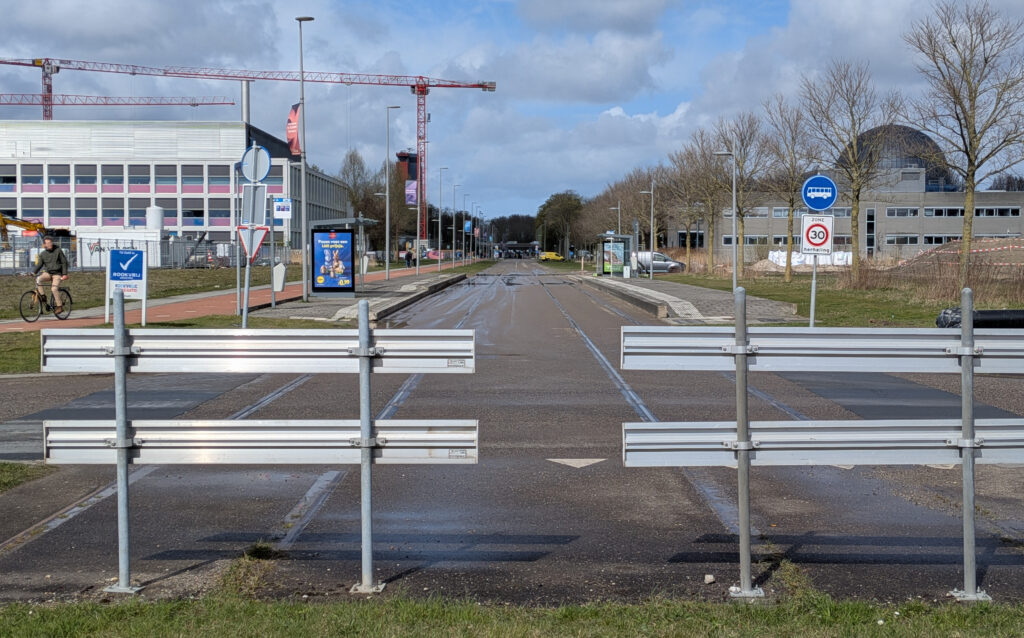
Oh, and for good measure, it was announced in 2023 that: “The tram only runs on working days from 7.00 to 19.00, every fifteen minutes in off-peak hours and in rush hour every ten minutes. The tram does not run faster than 30 km/h on campus and as soon as the tram starts running, bus line 69 is deleted”. I should point out that bendy-bus 69 does run all the way to the “Technopolis” science park, Monday through Friday, from 7:15 to 23:45.
But at last, they are triumphantly sweeping the floor of the recently installed platforms (not the old ones pictured above, those were built for nothing and will never be used). The first test ride scheduled less than two weeks from the date I am writing this. The wait is almost over.
The Plot
The last ingredient for today’s figure gives it some perspective, and a punchline I suppose. The tram would have been useful for me, if only they hadn’t cut it back and it wasn’t late by so many years. So I decided to make a second line counting down towards the end of my temporary contract. After a three-year extension, I thought I was again on track to use the tram. But further delays mean the opening date is now a month after I leave. Here’s the final figure:
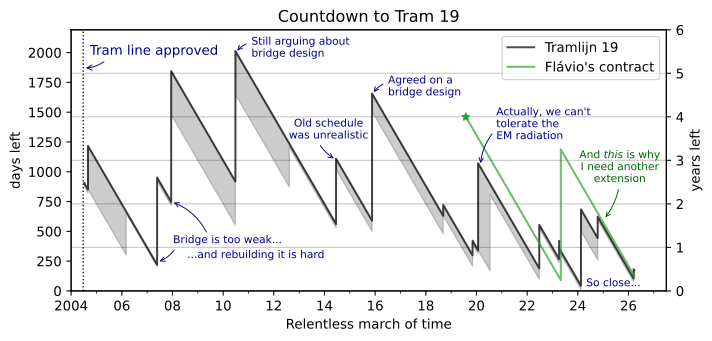
The gray areas represent the “ranges” considered, but the thicker line above is still more prominent. The vertical spikes really serve as a nice visual representation of the “setting back” feeling you get when a new delay is announced. The annotations try to tell the story in a few words, without polluting the figure too much.
Also, those of you who keep a protractor at hand at all times will have noticed that the lines are not actually at 45°. I didn’t use a 1:1 aspect ratio for the axes because this project is so delayed that the figure becomes ungainly. As a bonus, here’s a more chrono-geometrically accurate version:
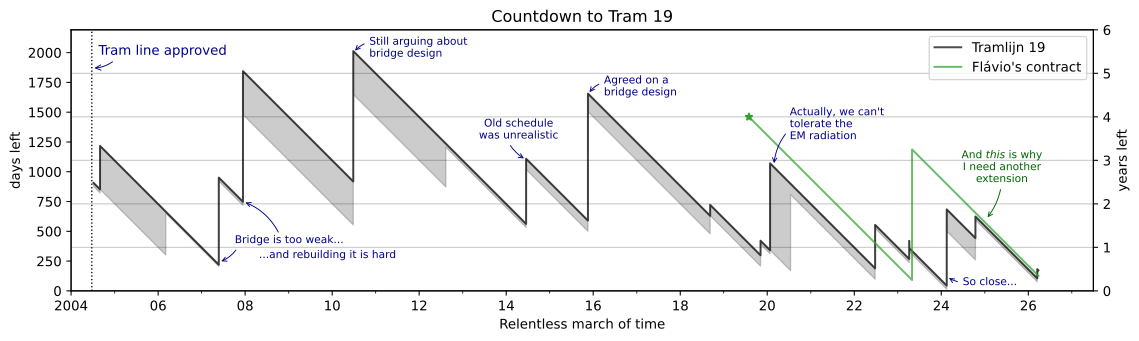
A final note is that I couldn’t bring myself to project the lines beyond the present day… I tried using the figure to argue why the university should keep me on their payroll, but to no avail. In conclusion, things are always late, but sometimes they eventually arrive. The tram got the last laugh.