Long winding intro
As an immigrant married to a twice-immigrant, I can’t help but glance at the torrent of ugly immigration related news coming out of the country with the most immigrants in the world (see these fancy plots for the answer). I find it to be a good distraction from all the anti-immigration stuff happening here, where I’ve migrated to.
Fans of the 2017 classic Trump Travel Ban®: Muslim ban? rejoiced when a sequel was released June 2025, dubbed the Second Trump Travel Ban®: Restricting the Entry of Foreign Nationals to Protect the United States from Foreign Terrorists and Other National Security and Public Safety Threats. With a presidential proclamation, the United States imposed a “full” travel ban on 12 countries and a “partial” travel ban on 7 others.
What this meant in practice was the prospective ban on visas being issued to persons foreigners from the targeted countries. “Full” here means a ban on all immigrant and non-immigrant visas. “Partial” means all immigrant plus some major types of non-immigrant visas: B-1/B-2 (business visitor / tourist), F/M (international students), and J (exchange visitor). In both cases, exceptions apply in a number of circumstances, such as for permanent residents, immediate relatives of U.S. citizens, participants of the upcoming FIFA World Cup and Olympic Games, etc. Don’t you love how the Olympics bring people together?
As the American Immigration Council points out in the article linked in the last paragraph, the justification for this was mainly based on three factors. First, the country’s screening and vetting of applicants and information-sharing with the U.S. Second, the likelihood of visa overstay and how easy it is to hand-wave a whole country and say “terrorist”. Third, how cooperative the country is in taking back deportees.
This ban was then expanded on December 2025. As of the start of 2026, nationals of 20 countries are now “fully banned” (including people with a Palestinian Authority travel document), while those of another 20 enjoy a partial ban. This expansion was the expected next step after the government continued its review on the subject, using the same stated rationale.
As this policy memorandum from January 1, 2026 by the U.S. Citizenship and Immigration Services demonstrates, the effect of these proclamations goes beyond stopping the issuing of new visas. Aliens from High-Risk Countries who entered the U.S. on or after January 20, 2021 will have their immigration benefits undergo a comprehensive re-review, requiring a potential interview and re-interview. Also, note that the restrictions are being applied to “aliens with a nationality, country of birth, or aliens who have acquired Citizenship by Investment (CBI) listed in PP 10998”. So just being born in a “high-risk” country is getting you banned, even if you don’t hold that nationality.
Anyways, I am not qualified to do that Family Guy meme to determine how terrorist-harboring each nationality is. So instead, I wanted to look into how U.S. visa overstay rates compare for nationals of various countries. Can these rates really explain the selection of countries for the ban?
An important disclaimer is that I am not looking at the actual merits of these decisions, whether any of this makes sense, or if these developments are good or bad. If you need to be told how to feel about these policies, you should first try soul searching in the lost and found, because you are likely missing something a random blog could not possibly provide. I just wanted to look at some data here, devoid of any deep political discussions.
Keeping up with the news
Things are moving very fast, and between me making the plot and writing this article, a big new restriction was enacted. On January 14, 2026, the U.S. Department of State decided to pause all issuances to immigrant visa applicants who are nationals of 75 countries, effective January 21, 2026. This was done so they could do a “full review of all screening and vetting policies to ensure that immigrants from high-risk countries do not unlawfully utilize welfare in the United States or become a public charge”.
Some of the 39 countries already banned are also included here, plus a fresh new 52. Presumably, divergences in the selections are due to this new restriction being justified more specifically on countries not being trustworthy enough on their own processes and not cooperating enough with the U.S. in sussing out the undesirables. As of February 16, 2026, this pause is still in effect, with no estimate of an end date.
There are cynics who are saying certain religions or ethnicities are being deliberately target with this restriction. Or that personal friendliness or animosity between U.S. and foreign leaders somehow play a role in these decisions. But as I said, these discussions are outside of the scope here. I did redo the plots however, adding a little extra indicator on whether a country is subjected to these newer restrictions or not.
Data
The Department of Homeland Security’s (DHS) Entry/Exit Overstay Report, referenced in the banning proclamations, presents the official fiscal-yearly estimates of how often holders of a non-immigrant visa overstay in the U.S. More precisely, this is how the latest report self-identifies:
This report provides data on expected departures and overstays, by country, for foreign travelers to the United States who were admitted as nonimmigrants at an air or seaport port of entry and were expected to depart in Fiscal Year 2024 (October 1, 2023 – September 30, 2024).
This report is the main evidence cited by that December 2025 proclamation to support the travel bans. So it’s worthwhile to make some notes before going to the figures.
Firstly, technicalities. What is and isn’t in the scope? This is how the report defines “overstay”:
An overstay is defined as a nonimmigrant who was lawfully admitted to the United States but remained in the United States beyond the authorized period of admission. (…) U.S. Customs and Border Protection identifies two types of overstays: 1) individuals for whom no departure was recorded (Suspected In-Country Overstays), and 2) individuals whose departure was recorded after their authorized period of admission expired (Out-of-Country Overstays).
Canada and Mexico are treated differently in the report, as a lot of people from those countries cross into the U.S. somewhere not an “air or seaport port of entry”. Only non-immigrant (which I’m sticking to hyphenate) visas are concerned. Some non-immigrant visas are also out-of-scope: “crewmembers, travelers in transit, and special protected classes under Section 1367”.
Secondly, one should keep in mind that the data come from the United States Customs and Border Protection (CBP) agency of the DHS. So, absent of any ways of independently checking the data, the federal government machine is kind of self-certifying the justifications for its own policies. Which is to say the numbers are only as significant as the credibility of the organization producing them.
Personally, I don’t see any reason why not to trust these specific reports at this point. But it might be worth to understand how the overstay numbers are produced, as they are perhaps overestimates. That American Immigration Council article refers to this piece from 2020, which in turn quotes from a report from a different think tank calling out “flaws” in the CBP/DHS visa overstay reports. The main issue raised is that overstay counts consist of all cases in which a departure could not be verified.
This would also include persons whose visa has expired but are having an application for a different “right to stay” being processed, such as an extension of their visa or a request for asylum. As the Executive Summary of the DHS report puts it:
Determining lawful status requires more than matching entry and exit data. For example, a person may receive a 6-month period of admission upon entry and then subsequently apply for and receive an extension for the period of admission of up to 6 months from U.S. Citizenship and Immigration Services. Identifying extensions, changes, or adjustments of status are necessary steps to determine whether a person has overstayed their authorized period of admission; this report was generated with improvements to data analysis in an automated fashion to better account for these changes.
In total, nearly 46.7 million “in-scope” air or seaport arrivals were expected to depart in FY24. From that, 539 thousand (1.15%) overstays were counted at the end of FY24 (October 1, 2024). Out of those, 483 thousand were suspected in-country overstays (1.04% of total). By February 6, 2025, that number had reduced to 427 thousand (0.92%) due to newly confirmed departures or changes in status.
Visa ABCs
Before getting into the plots, there is a final bit of background information needed. Visas as permissions to enter a country for a specific set of reasons. These can be broadly split into “immigration” and “non-immigration”, depending if the person is moving into the country or just visiting temporarily. As mentioned before, although the bans are (also) completely halting immigration from the affected countries, the overstay report only concerns non-immigration visas.
Within this category of “non-immigration”, there are still several classes of visas. In fact, the overstay report lists 48 different classes within its scope and 27 outside it. The report breaks down overstay counts into three parts, which I am labeling as “B”, “FMJ”, and “Other”:
- B: business or pleasure, consisting of B-1 (business), B-2 (tourism), Waiver-Business, and Waiver-Tourist classes.
- FMJ: students and exchange visitors, consisting of F1/F2 (academic students / their spouse and children), M1/M2 (vocational students / their spouses and children), J1/J2 (exchange visitors / their spouses and children).
- Other: every other in-scope non-immigration visa, including temporary workers and trainees, intracompany transferees, treaty traders and investors, alien fiancées of U.S. citizens and children, Legal Immigration Family Equity LIFE Act, attendants / servants / personal employees of diplomats and other representatives.
The U.S. has a Visa Waiver Program that basically gives the equivalent of a B1/B2 visa access to citizens of certain countries without them having to get a visa first. That’s what they mean when they say, for example, a Dutch person can visit the U.S. without a visa. In practice, you still need an “Electronic System for Travel Authorization (ESTA)”, and not everyone qualifies for this benefit (including if you visited certain countries without the purpose of bombing them). Terms and conditions apply, including a 90-day limit on visits like a B-class visa, so the numbers are presented alongside our “B” category.
For simplicity, because the proclaimed travel bans mention only the “B” and “FMJ” rates as justification, I ignored the “Other” category and looked only at the former two. Remember that these (B, F, M, J) are also the classes of visa being banned under the partial ban.
For the plot, I grouped countries of citizenship into “Full ban”, “Partial ban”, “No ban”, and “Visa waiver”. Separately from the Visa Waiver Program, Canadians can enter the U.S. under most circumstances (and for longer than 90 days). Likewise, citizens from the pseudo-colonies states freely associated with the U.S. have full freedom of movement (terms and conditions apply), i.e. the Marshall Islands, the Federated States of Micronesia, and Palau. For simplicity, I lumped all those four into “Visa waiver”.
Visas scattered in the wind (it’s just a scatter plot)
What I did was just take the overstay rates in the FY24 report and make a scatter plot with the “B” rate in the y-axis, and the “FMJ” rate in the x-axis. This choice was based solely on the fact that the latter are usually higher, I wanted the same scale on the axes, and I prefer a wider rather than taller plot (I’m a millennial who views things on a 16:9 monitor).
The main dataviz challenge was on how to indicate what country each point represented. There were 194 nationalities listed after all. An intermediate solution was to replace markers with the two-letter ISO code for the banned countries:
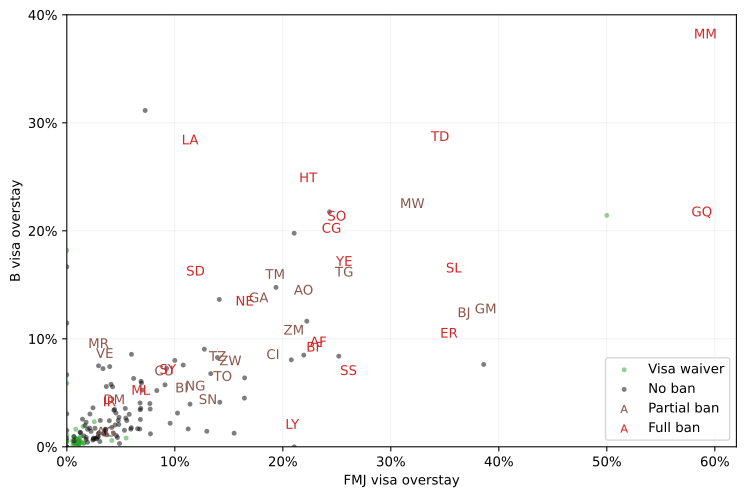
But most people are not going to immediately recognize the codes for these countries. I admit it’s not often I visit a .td, .gm or .bj website. Also, I realized you have to be careful when using letters as markers so that you don’t accidentally form offensive words. Niger to the left of Gabon was enough of a close call.
So the final solution was to add annotations to the countries with the highest rates. Because sorting out the layout of this would quickly become too much work if I manually added coordinates for each annotation, I chose instead to do it manually. And by “manually” I mean use my actual hand with a digital pen to write the annotations. Since I’m not used to use a digital pen like this, my setup was probably not ideal, and it took a while to get a passable handwriting.
Anyways, here’s the final figure:
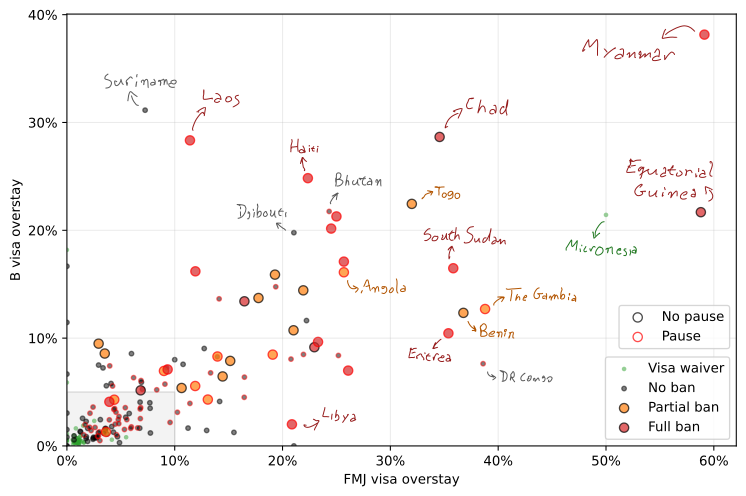
The “Pause” / “No pause” indicators relate to the pause in granting immigration visas started on January 21, 2026. Since its not directly related to the non-immigration visa overstay rates, and they were final additions to the figures (after I had selected the points to annotate), I won’t discuss them further.
So, generally speaking, yes, banned countries tend to have high visa overstay rates. You still have banned nationalities with lower rates than non-banned ones. This could be partially explained by FY23 rates, which can differ a bit from the FY24 values plotted, being used as justifications in the first proclamation from June 2025.
Another reason is that, as described earlier, overstay rates were only one of three “issues” used as justification. This is clearer when looking at the other extreme of the plot, i.e. the countries with the lowest overstay rates:
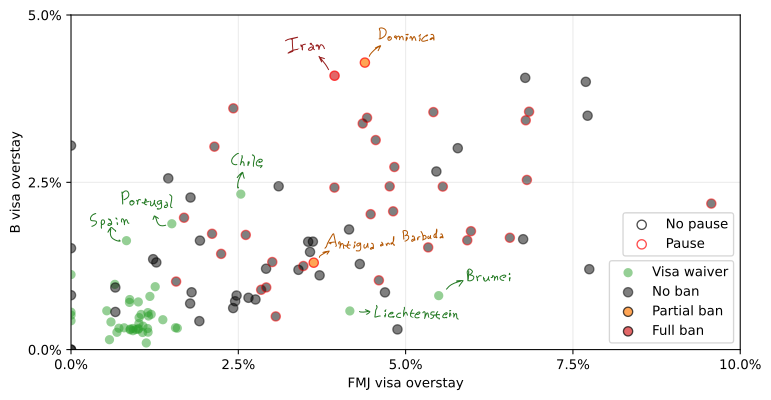
The U.S. has long added a big red label of “terrorist” on Iran’s figurative forehead, so no surprise on that red dot. Dominica and Antigua and Barbuda, on the other hand, are being banned due to having “historically had CBI without residency”. CBI meaning citizenship by investment.
Another obvious anomaly seems to be Micronesia, the only green dot far out on the plot. No Micronesian needs a U.S. visa under regular circumstances, there is a requirement only if you acquired citizenship by investment or if are naturalized and have not resided there for 5 years yet. The full freedom of movement enjoyed by the members of the Freely Associated States means there should only be an expected departure in these rare exceptions. So the “B” rate is 6 unverified departures out of 28 expected, and the “FMJ” rate is 1 potential overstay from just 2 expected departures. If you look closely at the y-axis of the first figure, you can see also Palau (2/11 and 0/4 for “B” and “FMJ”, respectively) and the Marshall Islands (3/51 B, 0/4 FMJ).
This is an argument raised in the criticism by the American Immigration Council, that the overstay rates “often are based on very small overall numbers of people. For example, the nation of Chad, with a population of over 19 million people, had just 377 suspected B-1/B-2 tourist visa overstays in 2023.” Although I can imagine the counter argument being that “well in that case the ban impacts few people anyway”.
In conclusion, I guess I made a couple of plots with colorful points and text on them. Not sure if that makes up for the feeling of the tightening grip of nationalism and isolationism all around us, while I live in a house with multiple passports, none of which of the country we reside in. People from high-risk countries seem to overstay their visits to low-risk (?) countries, but I’m not sure if we got cause and effect order right between high-risk and high overstay rate.
Also, hi to the immigration officer reading this when deciding whether or not I can visit Disneyland. Who am I kidding, it’ll probably be an AI scraping bot that will ingest this and spit out a Songbun rating with a confidence score.
Leave a Reply