Long winding intro
Unlock life in America
It has never been as appealing to be an American as it is today. I thought of making every word of the previous sentence a different hyperlink that illustrates this, but at this point you don’t need me to prove you this fact. However, being an American is not a right, it’s a privilege. A privilege that is, of course, the ultimate ambition of every single non-American in the world. Either you are an American, or an alien who dreams of being allowed to dream the American Dream.
God has only bestowed a select few with the blessing of being a red-white-ang-blue-blooded natural American, emphasis on the white. But because the Land of the Free is also a land of opportunity, if you are a non-citizen who has an outstanding work ethic, share the same American Values, is law-abiding, is not a threat to national security, has filled out all the forms in a timely manner, and has paid all the applicable fees, you may also be afforded the benefit of being allowed to life in the U.S. Eventually, even, you may even achieve the highest honor envied by billions worldwide, and receive citizenship of the United States of America.
But pump your brakes there kid, your decades-long journey gotta start somewhere. Referring back to the very start of the article, may I suggest the following:

Don’t confuse this with a golden visa (derogatory), the Trump Gold Card is a “visa based upon an individual’s ability to provide a substantial benefit to the United States. (…) nonrefundable, $15,000 DHS processing fee. (…) A $1 million gift upon completion of the individual’s vetting is evidence that the individual will substantially benefit the United States. An individual may also need to pay small, additional fees to the U.S. Department of State depending on his or her circumstances.” Under the hood, what happens is the provision of such fees and gifts may expedite your application for an EB-1 or EB-2 visa. This is the visa for aliens with extraordinary ability. Legal terminology, by the way.

Since I hold no such high ambitions for myself, I have to cope with my FOMO by just maintaining some curiosity on the whole thing; at a safe distance. And as I was reading up on migration news—on the only news source I will ever need—I came across a picture of the finish line I will never be lucky enough to see for myself: the Naturalization Civics Test. The news was that they were aligning it with Executive Order 14161 but, uninterestingly, the content of the test itself remained unchanged.
Having some previous experience with the equivalent test from a different country, I was curious what it looked like, and what would my chances be of passing it. An USCIS officer orally (ew) asks you questions until it is mathematically clear you are either American (12 correct out of 20), or merely an alien who filed Form N-400 (got 9 wrong before the 20th question).
The thing is though, these 20 Qs are sampled from a list of 128, which are published along with the exact answers you must give. So it is actually just a performative, ceremonial, memorization test, whose goal I guess is to enhance one’s Americaness to an appropriate level before giving them a passport.
Am I civil enough to be an American?
So, could I pass the exam? Yes, I still have good enough short-term memory. If I can memorize 151 Pokémon for nearly three decades and counting, I could memorize a hundred or so mostly one-word answers for a one-time exam. But I wouldn’t even have to, because the questions are quite easy, as you’ll see.
By the way, while the content of the test is still basically the same, they did replace the useless accompanying textbook for applicants to study for the exam. I don’t know why you would go through the trouble of reading all of that instead of going straight to the list of Q&As, but the “A More Perfect Union: Guide to the Monuments and Memorials on the National Mall for the 2008 Civics Test” was a cute harmless way of teaching civics and American history. This had already been replaced (in 2024?) by “One Nation, One People: The USCIS Civics Test Textbook”. Now they did a very minor update to that. For example, see if you can guess which is the 2025 version:
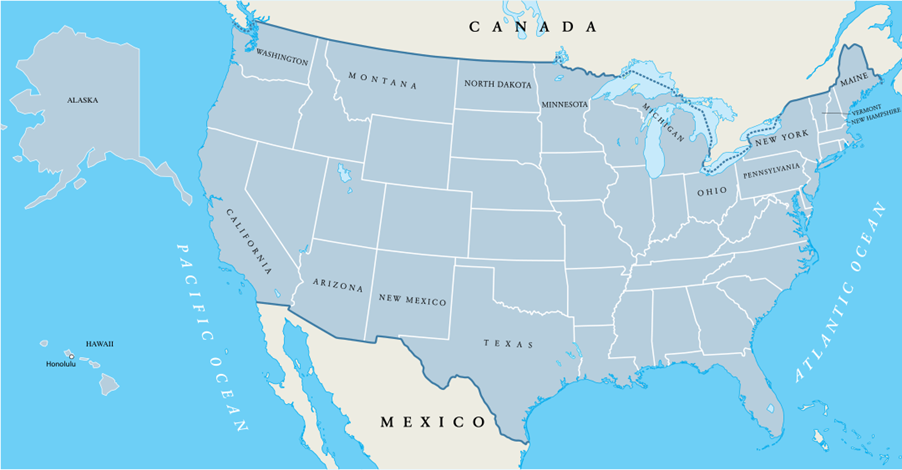
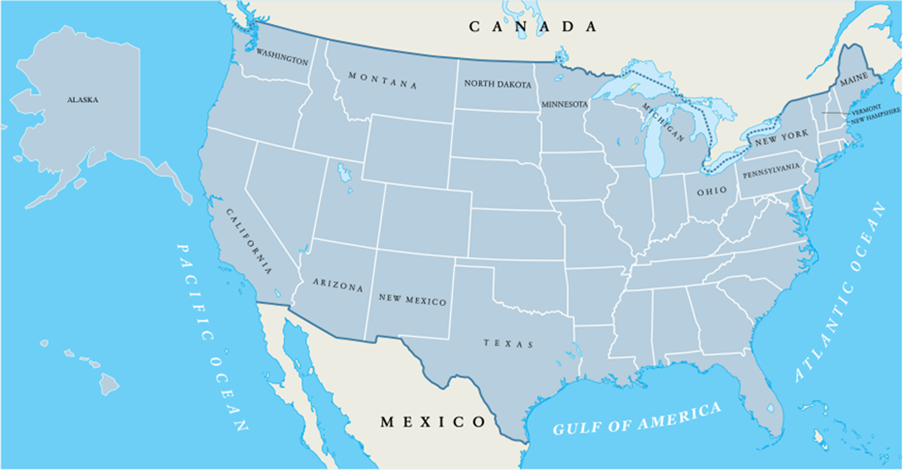
I have a theory that everyone thinks they are special. My country is not like other girls, and things of this nature. And because everyone thinks that, they aren’t; we’re all the same. Now, questioning American exceptionalism in these circumstances would surely disqualify you from naturalization and put you on an expedited path to learn about the Second Amendment. But when I took a look at the test questions, I couldn’t help but notice that some of them are not really unique or specific to the U.S. So this got me wondering, just how many questions of the exam could be answered correctly even if you knew absolutely nothing about the U.S?
I set about “taking the test”. Exactly how many questions of the 128 would I get right if I replaced “United States” with “Brazil” (and related wording), and answered accordingly? Then, what exactly would be the odds of passing the test for this unrealistically un-American applicant?
The experiment was fascinating, as some answers matched because the countries are similar, and others matched kind of by coincidence. The exact result depends a bit on how flexible I am in the “translation”. For instance, there were two questions that I was unsure, so I gave myself half a point each:
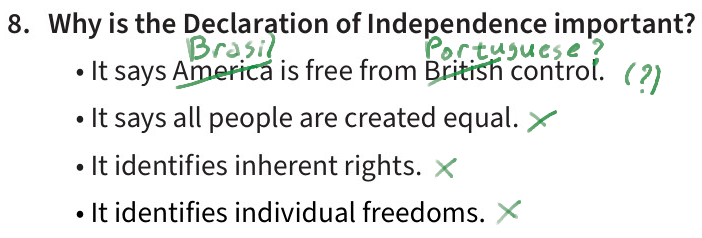
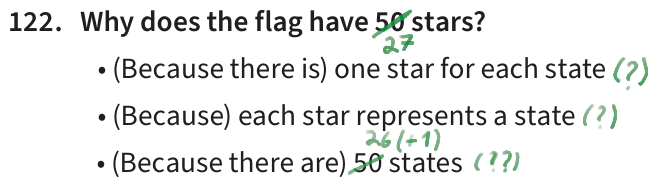
You could argue that the Declaration of Independence did not say Brazil was free from British control. And no, the Brazilian flag does not have 50 stars.
Tallying up the scores, I counted 55 correct answers. This implies that I am, legally, 43% American. Which, given my parents, actually makes some sense. Another valid interpretation is that Brazil is 43% the same as the U.S., and that the flag below shall be henceforth flown from all staffs in Brasília. Since it used to be the flag of the United States in 1819, this also means Brazil is some 206 years behind. Which, likewise, fair enough.
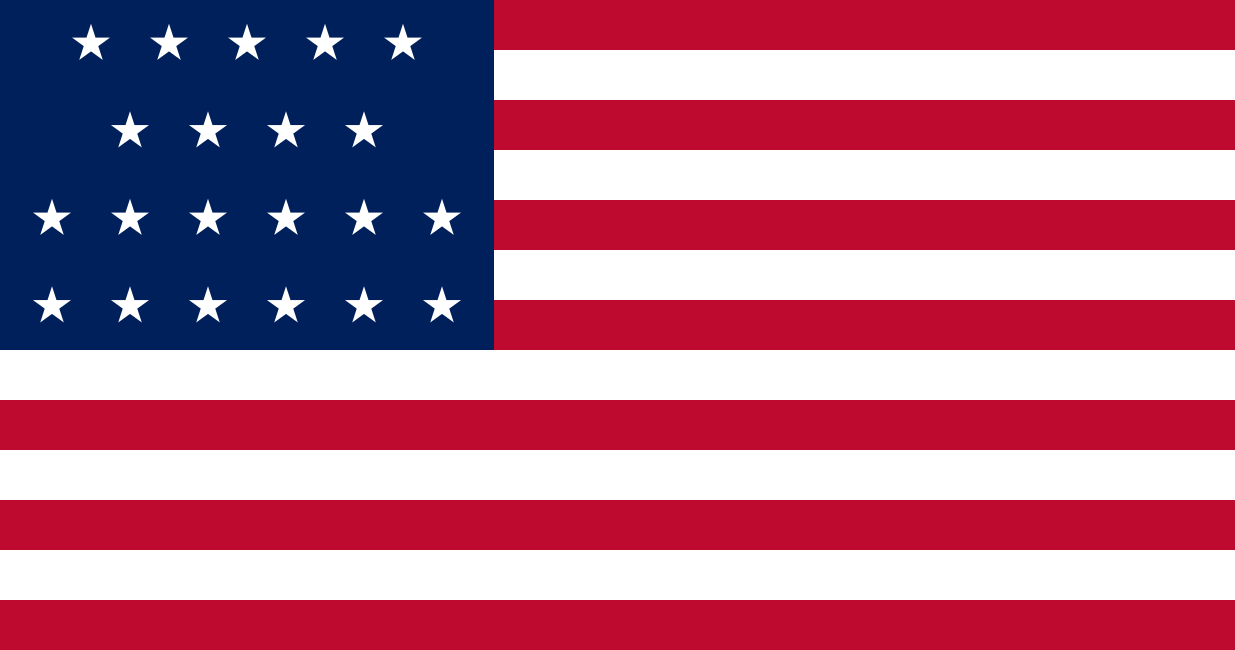
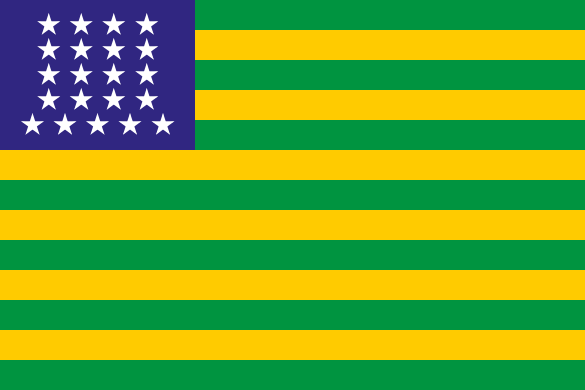
Fun fact, when Brazil became a republic in 1889, the first idea for a flag was to just copy the American one. Coincidentally, that flag also had 21 stars; the American one had 38 by that time. The following design was used for less than a week before they invented having shame, and a more original design was chosen
.svg)
But hold on a minute. An alien needs a score of 60% to pass the exam, so does this mean I’ve failed? Not quite. All is fair through the magic of probabilities. Dusting up some of that knowledge I didn’t pay to learn at college (or was this in high school?), I recall (Wikipedia recalled) that the chances of getting at least 12 passable questions would be:
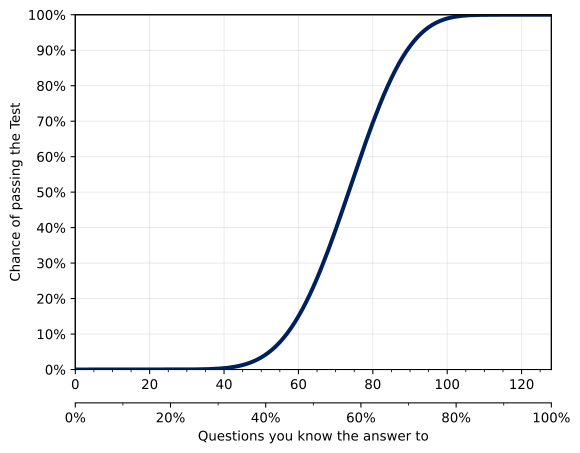
So Brazil has a 1-in-(a lucky)-13 chance of a pass. Note that I assumed questions would be picked randomly. I would imagine they actually pick a few questions from each subject, but for the lack of better information, this will do for the analysis. Our plot for today is how the odds change if fewer or more questions match. You’ll find that below.
1 in 13 is not great, not terrible. But since naturalization is a serious endeavor, you don’t want to leave it to chance. Therefore, we should psychologically and financially prepare ourselves to take the exam enough times to be confident in a positive outcome. Scientists like to use 95% for some reason, so let’s stick to that:
Which gives… . I don’t know how long it takes for the whole scheduling procedure and so on, but I’m sure it’s all very reasonable. Money-wise, the form to apply for naturalization generally costs $760, or just $710 for an online application. However, you may notice that, as of Q3-2025, the average monthly income in Brazil is R$3,528, which Google tells me is around 630 USD at the moment. This should comfortably put you below 400% of the Department of Health and Human Services Poverty Guideline, which in 2025 sits at an annual income of $62,600 for a 1-person household, meaning you can apply for 50% off discount on the N-400 fee. Hell, the Belastingdiesnt can confirm I still to this day qualify for this generous offer. All told, setting aside $14,440 should be good enough for our exam expenses.
Person, woman, man, camera, TV: 65/20 rule
Because the Test is actually a ceremonial affair that relies just on the sharpness of your memory, there is a small problem. Memory degrades, as the 15 minutes my SDD sometimes takes to boot up demonstrates. So there is a Special Consideration for applicants 65+ years old and who have been lawful permanent residents of the U.S. for 20+ years. In this case, you need just 6 correct answers to 10 questions from a reduced 20-question pool.
This is short enough that I can copy here all the Brazilian answers to give you a taste of the exam. It also makes it reasonable for me to try to verify if the Netherlands would do any better in this regard.
[SPOILER: 20 questions]
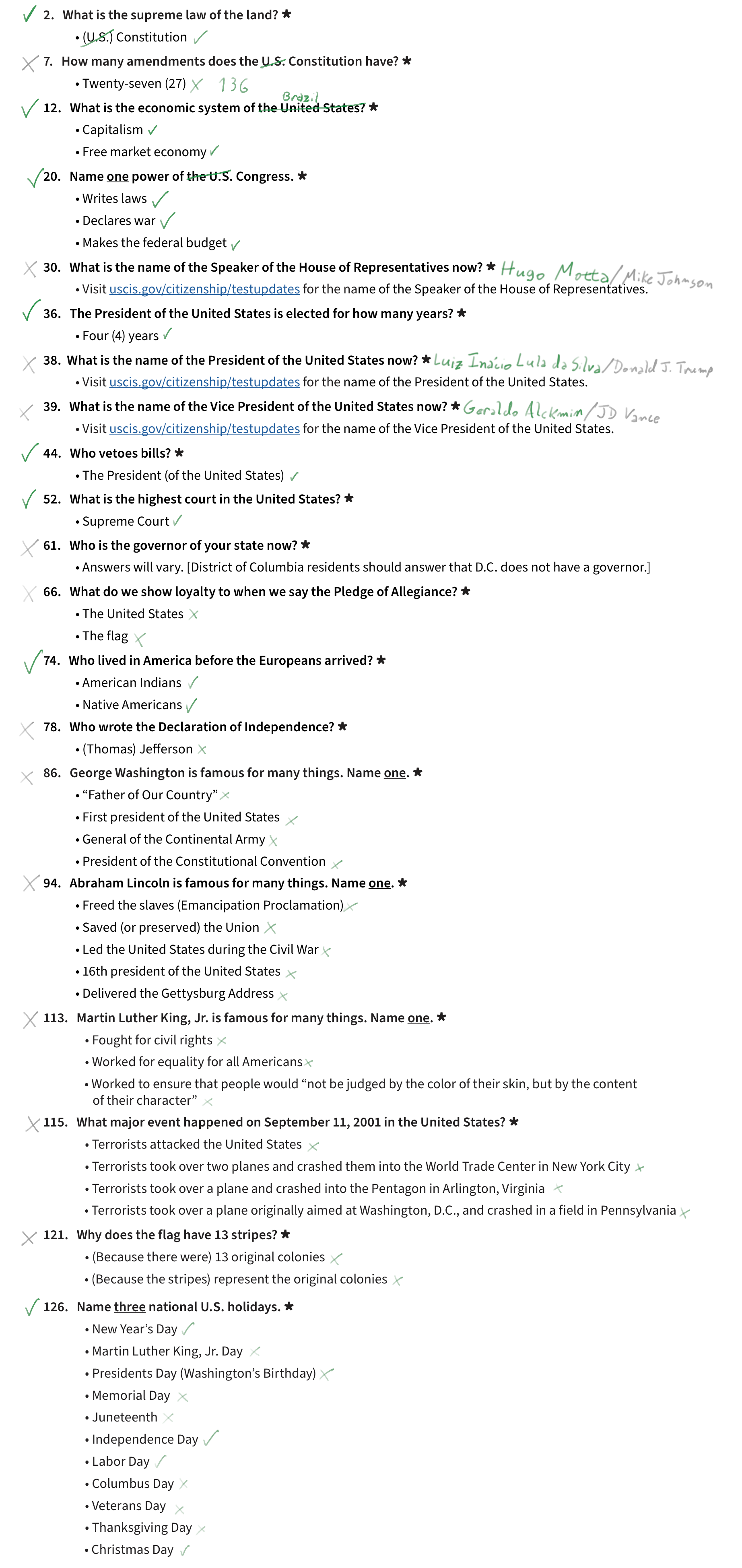
Brazil does about the same in the shorter test: 8 out of 20 (40%). But for inexplicable reasons (math), the odds of passing the exam are a little bit better: 8.5%.
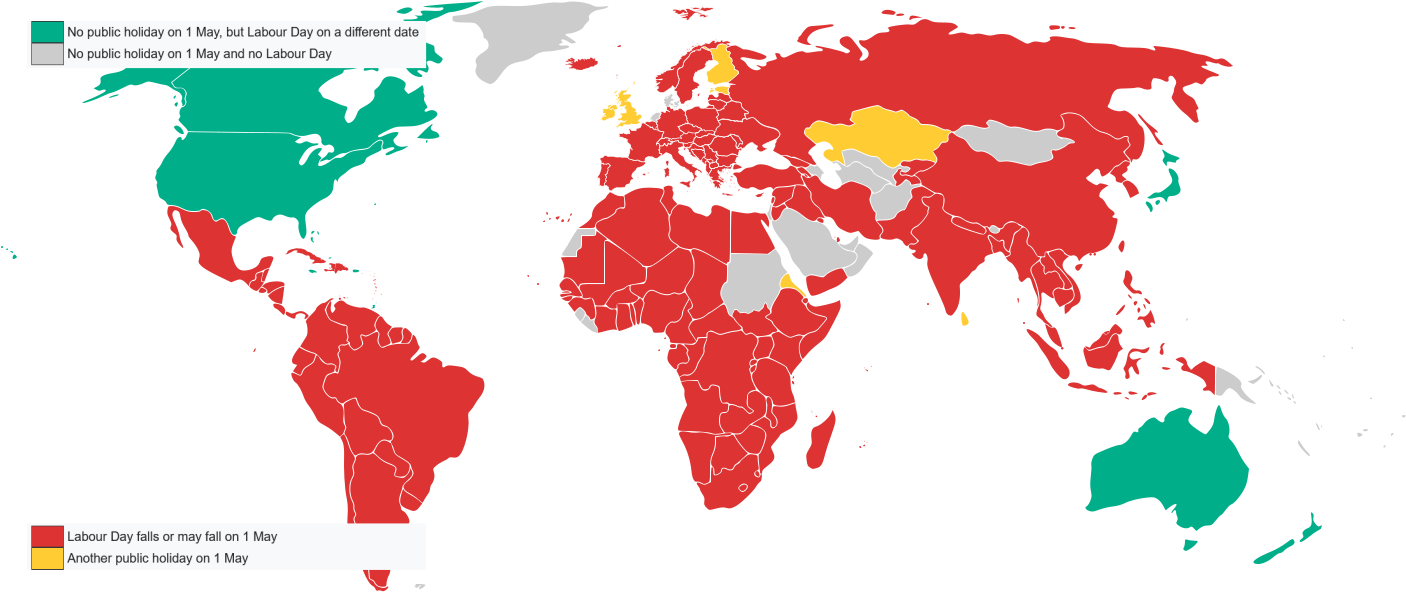
The Netherlands does worse, getting only 4 answers correctly, making it impossible to pass. The differences are: Brazil has a president elected every 4 years, who vetoes bills; Native Americans lived there before Europeans; and we have national holidays for Independence Day and Labor Day.
That last one is about names of holidays, not dates. The day Brazilian Will Smith nukes a bunch of aliens (not those aliens!) is September 7. And the Dutch are very American in that they eschew May Day, because communism. In my house, Loyalty Day is the most important day of the year. But the Dutch do go overboard on capitalism, as we have no labor day at all here:

Brazil is more American than the Netherlands, okay, but can we do better than that? We have to look in the Americas to get the Native Americans question right. Three of the twenty questions are about specific persons, so it’s impossible to get those. Only the U.S. has a national flag with 13 stripes. Maybe there is another declaration of independence written by a “Jefferson”, but it’s unlikely. No major event happened on 9/11, 2001 in other countries.
There are two other American countries with a “pledge of allegiance” wiki page. But the Bahamas does not have a president. Mexico does, but the president has a 6-year term and might not be able to veto bills (?).
Though unlikely, some other constitution might have 27 amendments, but I’m not going to check that. I think the best hope lies in having a name match. I am not sure how to evaluate the “who is the governor of your state”, because what would I compare it against? Finally, given current answers, I could not find any matches for President, Vice-President, or Speaker of the House. Even with the name “Johnson”. But this could change in the future. We will keep a close eye on this. For the time being, I’m afraid you cannot find a more Americanable country than Brazil.
Plot
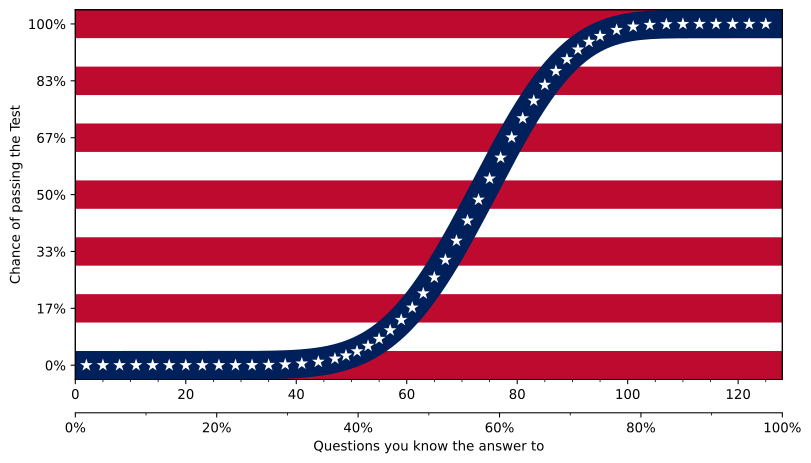
I started with a simple plot to see how the odds of passing the test would change with the numbers of answers that matched. In trying to make it prettier, I thought it would be a nice touch to use the colors of the American flag. Which is when an idea came to me and I realized what was the true manifest destiny of the plot: to be in the format of the star-spangled banner.
Because it ended up being quite style-over-function, I still put the finishing touches on a more conventionally formatted line plot, as a more readable version:
Below is a bonus preliminary version, when I colored the gridlines red. It was at this moment I decided to go all-in on the flag theme. Comparing it to the other two versions shows my line of thought and how the stylistic choices came to be.
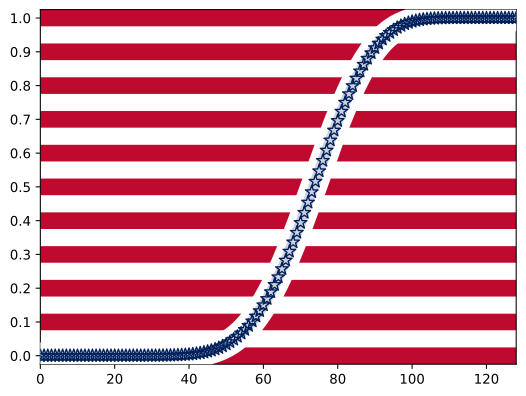
Gridlines became the 13 stripes. That spacing is nice because it marks the odds in steps of 1:6, like the common die. After markers became stars, it was clear I should keep only 50 of them. You can notice that their horizontal spacing is not uniform, with a star every 3 questions in the edges and every 2 in the region around the line’s highest inclination (50% odds are between 73 and 74 questions). The aspect ratio also changed to approximately match the 1:1.9 of the flag.
P.S.
I wrote this in 2025. Maybe it was all a moot exercise, and all we have to do to become Americans is wait.
Leave a Reply